#374: Blue note
It's 1998 again. Come record shopping with me!

If this is your first time reading Hit Points, welcome! It's a weekly-ish newsletter about trying to have fun in the game industry by me, game consultant and former Edge editor Nathan Brown. It's almost five years old somehow! You can subscribe for free right here, and can support my work and get extra exclusive posts for £4 a month here. Or you can just read it and enjoy it, that's fine too. (You should subscribe tho imo.) Thank you!
You may already be familiar with the song ‘Out Of The Blue’ by System F, one of several noms de plume used in the 1990s by Dutch trance kingpin Ferry Corsten. Bouncy, catchy and almost comically upbeat, it’s a perfect encapsulation of a very particular style of electronic music — one whose buzzy synth lines were unforgettably compared by one of the music mags of the era to ‘wasps in a tin’ — that was played and danced to in some very particular, and let’s be honest peculiar, places: Gatecrasher in Sheffield, Peach in London, God’s Kitchen in Birmingham, etc.
Out Of The Blue was a hit. Like a lot of ‘90s floorfillers it successfully crossed over from the club scene to the radio, enjoying a brief residency in the UK Top 20 as a result. It took pride of place on countless CD mix compilations, blasted out of town-centre car radios and suburban shopping-mall PA systems, and in perhaps its clearest sign of its effect on The Culture, was featured in rubbish-but-nonetheless-seminal clubland flick Human Traffic. Years later it popped up on the soundtrack of the sadly under-remembered Vita launch title Lumines Electronic Symphony, but that’s by the by. The point is that, for a while, Out Of The Blue seemed to be absolutely everywhere. I, however, knew it when it was nowhere.
I first heard it one Friday night at The Gallery, a trance and hard house weekly at Turnmills in Farringdon that, for much of 1998, was my second home. It almost took the roof off the place. In such moments I would often knock on the door of the DJ booth, press my face against the glass and ask what the record was with a series of daft/pleading gestures, but this was not one of those times. I would like to imagine that I was just lost in a moment of shared wonder, reaching for the lasers along with several hundred like-minded souls to the sounds of some hot new tune. But to be honest I expect I was just sat in a corner somewhere, chatting bollocks to someone I’d just met, too fucked up to move. I did a lot of that back then. I was very good at it.
The following Saturday, Judge Jules played it on his BBC Radio 1 show; he said nothing about it, but I recognised it immediately, successfully dashed to the stereo in time to hit record, and listened to the tape of it on repeat to and from work the following week. A Friday or two later, Pete Tong — who it would later emerge had flown to Amsterdam, had Corsten meet him at the airport, and signed it to his label on the spot — played it on his own Radio 1 show. This time, he had info, after a fashion anyway: he said it was the untitled new track by Moonman, another Corsten alias.
This was enough to go on back then, particularly if you lived somewhere like London, with its plethora of record shops. The quest could finally begin. I hopped on the tube into town the next day.
I was going about it all wrong, and I knew it. The place most likely to have it was a particularly well-regarded shop in Covent Garden called Plastic Fantastic. The most efficient course of action would’ve been to head straight there, then circle back to Soho, with its densely packed plethora of record emporiums, if I struck out. But I didn’t, firstly because Covent Garden on a Saturday was bound to be an absolute shitshow, but also because Plastic Fantastic scared me a bit. There was an attitude in there; they were too cool for school, famous both for being frequented by big-name DJs and for treating the hoi polloi with a detached scorn that made Jack Black’s character in High Fidelity look like a kindly nursery teacher. I figured they’d look at me, barely 22 and clearly out of my depth, and send me packing.
You know what happens next, of course. After trying and failing all around Soho I walked nervously into Plastic Fantastic, went up to the counter, and waited several minutes for the guy 18 inches away from my face to pretend he’d only just noticed me. I cleared my throat, affected a tone of voice that I hoped would mask my desperation. “Have you got the new Moonman?”
He looked at me sceptically for a moment. Then he leaned over the counter and actually, literally looked me up and down, deciding if I was sufficiently deserving of his precious treasure. He looked at me again, eyes boring into the very depths of my soul, and I thought, ah, here it comes. The laugh, the sneer, the aloof ‘never heard of it mate’ or whatever else the fates, in cahoots with this awful prick, had in store for me. Instead he slipped his hand under the counter, withdrew a record — white-label promo, unidentifiable but for the label wonkily glued to the sleeve — and said, “Twelve quid.”
Reader, I walked out of that record shop feeling ten feet tall. It was the coolest I had ever felt by a distance, and almost 30 years later I’m not sure I’ve ever topped it. It’s a terrible record, of course. Dumb body music for unthinking young people on good drugs. But that’s exactly who I was in 1998, and it’s a journey, and a story, that I have cherished ever since.
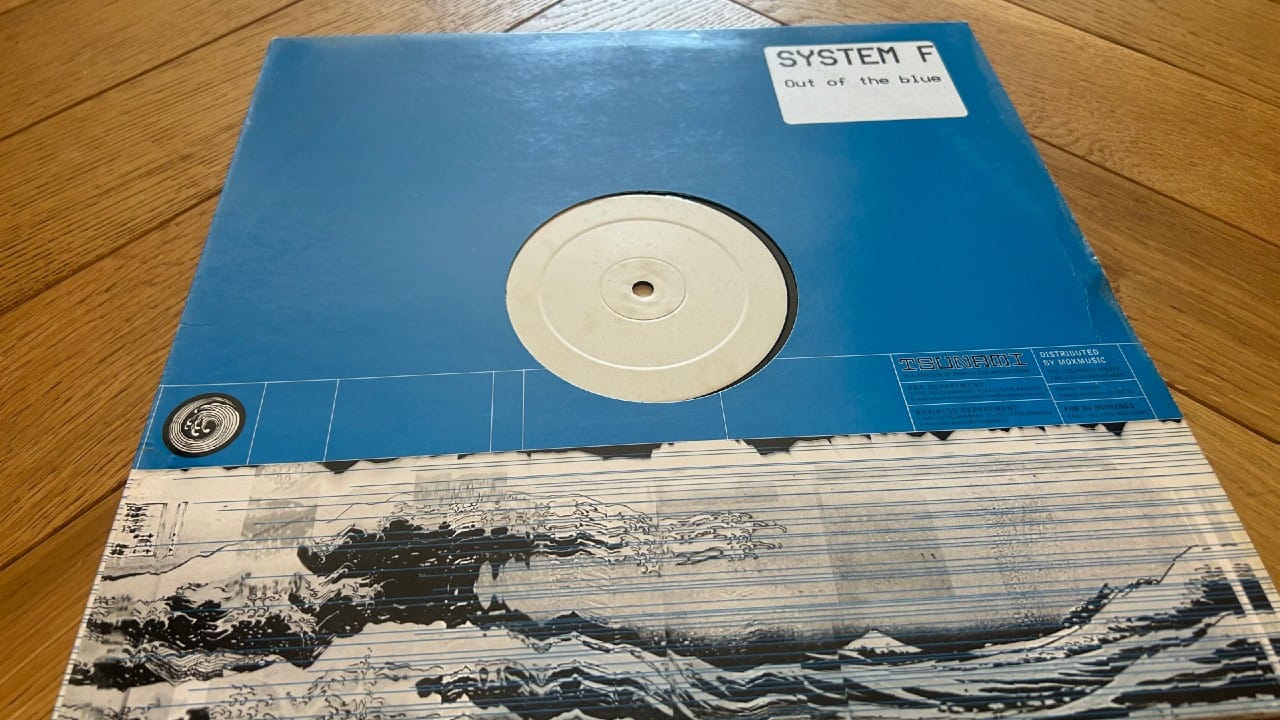
I’ve been thinking about my quest for Out Of The Blue a lot recently. Not just because I turned 48 on Monday and am feeling the passage of time a bit, though that is certainly, regrettably part of it. Not just because it came on in the car on the drive home from school a couple of months ago and I ended up telling the eldest the whole story, which required so many breaks for context — about the role of radio DJs as tastemakers, the precious currency of blank cassettes, the record-store gatekeeper trope, and on and on — that it took up most of the journey, though naturally that’s a factor too. (He liked the song, FWIW. He’ll grow out of eventually, I’m sure; if I can do it, anyone can.) It’s not even because I played Mixtape over the weekend, have Big Feelings about it, and have spent the week feeling very ‘90s-y, which we’ll get into on Friday.
I think it’s because it shows how hard we had to work to discover stuff we liked back then, and how much deeper a relationship we enjoyed with the things we discovered as a result. When I went over to my record collection a little while ago to dig out my copy of Out Of The Blue for the photo above, I knew exactly which shade of blue I was looking for as I scanned the shelves. (It still took me half an hour to find it, mind you, and every time I stood up or shifted position my knee gave an ominous click and I could, and probably should, have just grabbed the image from Discogs but still, you get my point.) I may not have another story quite like it, but as I flipped through each pile of tunes I was assaulted with memories; split-second snatches of sleeve art reminding me of places I’d lived, people I’d known, often the specific shop I had bought a given record from and where I was in my life at the time I bought it.
Late last year I sacked off most of my streaming subscriptions, built a home server, and re-ripped my old CD collection. I still buy (and otherwise acquire) plenty of music, but it’s stuff I am interested in, or at least curious about; stuff, most importantly, I have sought out by myself. My relationship with music is much more intentional now and I feel more connected to the things I listen to than I have since... well, since Spotify came along, I guess. That feeling when you're listening to an album you know really well, and you can hear the start of the next song in your head a few seconds early? It's great! I had forgotten about it, and didn't realise how much I'd missed it.
Music might not be as important to your life as it has been to mine, but I’m sure you know the feeling. Maybe you, too, have a cherished memory of some long-hunted white whale — a book or comic or film; perhaps even a videogame, which I’ve just remembered this newsletter is supposed to be about — that you looked for everywhere you went and were so close to giving up on, until it showed up in a dusty second-hand shop in a seaside town that you only went in to escape the rain, or whatever.
I see no good reason for confining these stories, and these memories, to history. If anything I think we should all work a little harder to make them part of our modern lives. We have been trained to expect our #content to be beamed directly to us by ever-changing algorithms that are governed by people who, we now understand, have never had our best interests at heart. We should probably, like, not do that anymore, I think? Games might be a bit removed from the worst excesses of Big Tech, but how many of us let the way we engage with our hobby be dictated by the release schedule, the movements of the Game Pass library, some dreadful Discourse-driven FOMO, or whatever freebie’s just been flung at us by PS Plus or Epic Games? We are outsourcing curation to capitalism! This seems a bit silly!
We talk a lot about discovery in the game industry, but the discussion is incredibly one-sided, talking only about how difficult it is for developers to break through the impermeable walls of digital storefronts and actually put their games in front of players. And sure, that’s a problem, I get that. But the entire discussion operates on the assumption that consumers no longer go looking for things. Unless you can find a way to put something right in front of their eyeballs, they will never know it exists. That's incredibly depressing. I think perhaps it’s time it changed.
I am already trying, in my own small way. A few months ago I consulted on a game in a genre with which I am not enormously experienced, and have never particularly enjoyed. After some back and forth with the client about my lack of expertise — all good; they'd already secured the services of a genre expert, and would value my generalist perspective — I accepted the gig. I expected to hate it, but I had a really good time, and after the work was done and I’d sent off my invoice, I found myself hungry for more. What else had I missed in this genre over the years?
And so I embarked on a quest of sorts. I filtered the PlayStation Plus catalogue by this hitherto underexplored genre. I looked at every single game; I watched their trailers, skimmed their screenshots and store descriptions, looked up a few Metascores. After that I spent half an hour doing the same on the PlayStation Store at large. It was a thankless, perhaps even fruitless task, but I’m glad I did it. I eventually made my choice, paid my money and felt really good about how intentional a process it was. I played the game for like half an hour and fucking hated it of course but look, that’s not the point.
The point, 1880 words later (sorry! I really am!) is that it’s high time we stopped talking about discovery like it’s just a developer problem. We have, however accidentally, allowed digital stores to become the modern-day prick in a record shop — deciding what goes on the shelf and what stays under the counter, what sells and what doesn’t, who even gets to know about what. It is time we learned, once again, to dig in the crates; to put the work into how we engage with the hobby, and take back control of it in the process. Who knows, we might even get a cool story or two out of it with which to regale some baffled youngster in a couple of decades. Chuck in some good drugs, and the flat stomach and boundless energy of a 22-year-old raver, and we’ll be off to the fucking races.
Jeez, that was bigger than I’d planned. I hope it goes at least a little of the way to atoning for my unforgivable silence last month, for which I am very sorry. I can’t even do a Playlist for April because everything I played is under NDA. Annoying! But unavoidable from a financial POV, I’m afraid. Will make it up to you. See you tomorrow!