#367: From hell
On the heinous, nightmarish, unspeakably vile DLSS 5.

Before we get into the honkingly rancid meat of today’s edition, I want to make it clear that I think DLSS is brilliant. Nvidia’s fancy upscaling tech may not be as sexy as stuff like ray or path tracing, but is for my money the most significant development we have seen in PC gaming for years, primarily for its ability to actually bring the aforementioned sexy stuff within reach of more than just the highest of high-end machines. It has also washed away a lot of the claggy obstructions we traditionally associate with the nerdier side of playing games on PC. You no longer need to obsess quite so much over the finer details of the settings menu; just pick a preset and let DLSS sort it out. I will be doing just that when I finish today’s newsletter, and settle down in front of the fascinatingly divisive Crimson Desert, safe in the knowledge that I’ll be able to wallow, if only for a while, in its evident visual splendour without sitting next to a PC that sounds like it’s about to take off and then explode.
For Nvidia, DLSS, along with its nerdier subsidiary technologies such as Frame Generation and Ray Reconstruction etc, has also served as a handy goodwill generator. None of these things are the reason Nvidia has become the planet’s most valuable company; we have the crypto goldrush, and our current AI-scented insanity, to thank for that. But the knowledge that within Nvidia there still exists a boffin cabal focused squarely on consistently improving game technology — and often, crucially, in ways that are possible on cards that are already on the market — has enabled us to look the other way, if only for a while, whenever Nvidia CEO Jensen Huang saunters onto a stage in his silly biker jacket to talk about genAI. We know that Nvidia, if only in some small way, still cares about games.
All that went out the window, I am afraid, with this week’s announcement of DLSS 5.
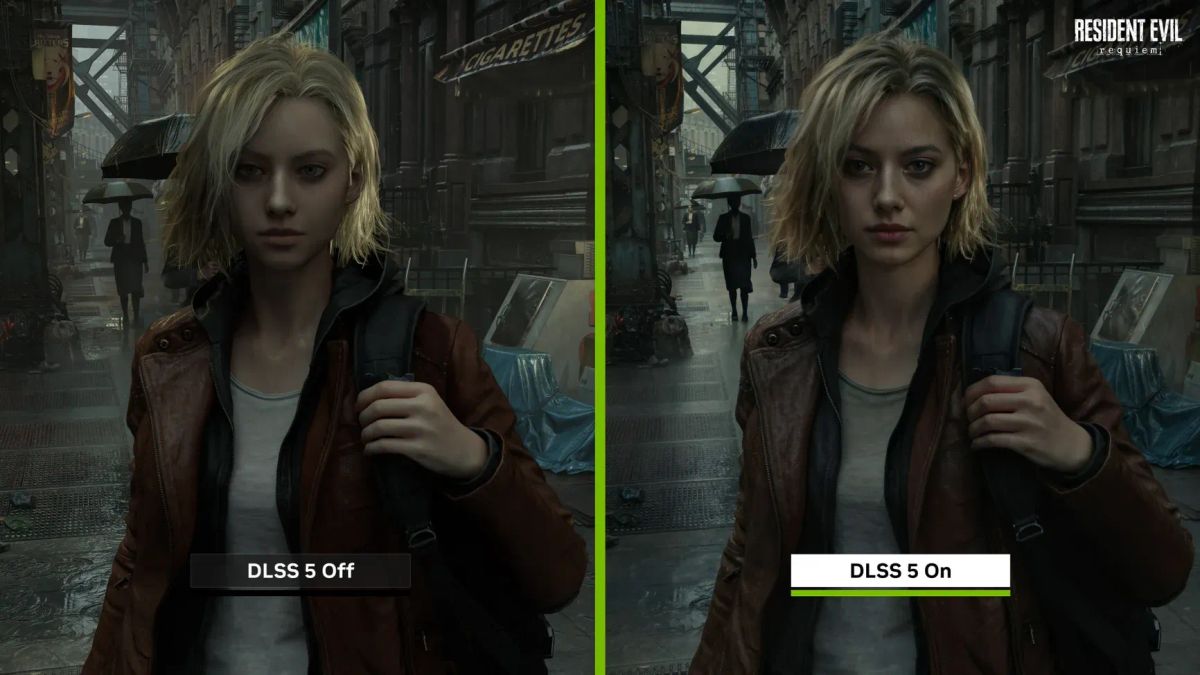
If you’ve been anywhere near an internet this week, you’ve probably seen the screenshots. Perhaps you’ve watched the videos from which those screens were grabbed. You’ve almost definitely seen the memes because there were billions of them, and some of them were very funny. DLSS 5’s headline feature is an on-the-fly genAI-powered ‘enhancement’ of a scene that, as far as I can tell, has two main effects. Firstly, it tarts up on-screen environments in a way that mostly reminds me of the dreaded ‘Dynamic’ setting on HDR TVs; it drags the colour temperature slider to the coldest setting so that everything looks horridly oversaturated and greasy and blue. Secondly, and far more troublingly, it applies a genAI glowup to character models that makes everyone under 50 look like they’re in an AI advert for an unspeakably porny mobile game, and everyone older look like a particularly sunworn prune with eyes. The filter has no care for context — which is why the DLSS5 version of a 15-year-old Hogwarts Legacy character looks about 30 — or continuity, which is why two shots of Resident Evil Requiem protagonist Grace Ashcroft appear to show us two different people.
Nvidia’s walked things back a bit since the grand unveiling, responding to the clamour by insisting that all of this will be controlled by game developers, who’ll get to choose how and even if the filter is used. It reminded foaming onlookers that all the enhancements shown off were agreed with each game’s creators, though if you think that approval process got anywhere near the actual development floor at Bethesda, Ubisoft or Capcom then I’d like to talk to you about an exciting investment opportunity in the monorail industry. That’ll have got about as far as the brand director before being waved through; most likely the email went no further down the chain than the C-suite. I doubt there is an art director on the planet who didn’t look at this stuff without wishing they could claw out their own eyes. In a last desperate grab for legitimacy, cutesy Bethesda mascot Todd Howard was wheeled out to talk about his excitement for the new technology, which comes as no surprise given his studio’s track record for relying on free labour to actually finish its games. The distinction between modders and AI filters rather evaporates when you’ve got as many leather jackets as him.
I am sure I don’t need to tell you how I feel about this, which is just as well because five days on from the announcement I still struggle to articulate it. My initial reaction was a sort of instinctive, unspeakable revulsion; just, like, get this fucking thing out of my sight immediately. It is an affront to the artform, to the very notions of creative excellence and technical wizardry that have kept me playing videogames for 40 years and compelled me to build a career around them. Worse than that, it is Nvidia reminding us exactly where its priorities lie. I’ve seen this described as a PR disaster; as if Nvidia didn’t realise who it was speaking to, that it failed to anticipate that turning a showcase of game graphics technology into so much grist for the slop mill would have its intended audience scurrying for their pitchforks. The reality, of course, is the opposite. This was entirely the plan. We stopped being Nvidia’s most important customers a while ago, we all know that. But this week something shifted. AI is existential for Nvidia, more so than any other company in the world, and it no longer cares who it has to upset in order to ensure its success.
MORE!
- This Subnautica 2 business, holy hell. Earlier this week a court ruled in favour of the three co-founders of developer Unknown Worlds, ordering that former CEO Ted Gill be given his job back and reassume immediate control of the studio's operations, including the game’s release date. The judge’s full ruling is an absolute goldmine, including the revelation that Krafton’s CEO sought, and followed, legal advice from ChatGPT even after his company’s in-house counsel had told him that, no, you can’t just fire some people because you don’t want to pay them the $250m you owe them. That, you’d think, would be that — but the next day Steve Papoustis, who was parachuted in as Unknown Worlds CEO after the co-founders were fired, announced Subnautica 2’s early-access release date, in direct violation of the court order. Gill and co’s lawyers are, as you’d imagine, kicking up a right old fuss about it. What a grisly business. Very stupid too, if I may say so!
- I had no time last week to talk about PEGI’s new guidelines. The European age-rating body unveiled a raft of changes, due to take effect in June, aimed at grimy monetisation and addictive design that will see games with battle passes auto-slapped with a PEGI 12, and anything lootbox-adjacent — card packs, gachas etc — rated 16. It’s all very Big and Serious, and seems to be at least in part designed to stave off the threat of even worse government regulation, but PEGI’s US equivalent, the ESRB, doesn’t fancy it. “There are currently no plans for ESRB to allow any factors outside of the content and context of a game to influence the age-rating assessment,” a suit harrumphed.
- Yves Guillemot’s layoff buzz must be starting to taper off again because Ubisoft is ending game development at Red Storm Entertainment, the North Carolina studio that spent the bulk of its 30-year existence making Tom Clancy games, with 105 jobs gone as a result. Ghouls. In related and equally infuriating news, Crystal Dynamics has conducted its fourth (!) round of cuts in the last 12 months, with another 20 staff sent packing. For what it’s worth the studio insists that release plans for its two in-development Tomb Raider games — a remake of Legacy Of Atlantis and the all-new Catalyst — are unaffected.
- Meta has ended development on the VR component of its great white Metaverse hope, Horizon Worlds. The smartphone version lives on, if you can call it that. Seventy-seven billion dollars, ladies and gentlemen, and all they really had to show for it were some belated legs.
- Hitman maker IO Interactive has ended its publishing deal with troubled Edinburgh conspiracy factory Build A Rocket Boy, following the dismal performance of the studio’s debut MindsEye and, you know, all that other stuff. Surprised it took this long, honestly.
- There’s a Cyberpunk 2077 trading card game on Kickstarter and sweet heaven it is absolutely flying. The game, a collaboration between CD Projekt Red and a Seattle company called WeirdCo, launched on Kickstarter a couple of days ago in search of a modest seventy-five grand. As I type it’s been backed to the tune of more than £8m. CDPR must be delighted, but I bet the WeirdCo crew are absolutely shitting themselves. No pressure, gang!
- Before I forget, because I have persistently managed to forget this for weeks now, Hit Points tips its hat to Matthew Reynolds, veteran guidesman of Eurogamer and Polygon, who has launched a new reader-funded Pokemon site called One More Catch. FWIW I think this is absolutely the way to go now the indie-media landscape has become so cluttered: a super-tight brief, focused on a single niche that has a large enough potential audience to sustain it. Good shit. Unfortunately the launch deal, which gave you 10% off for the entire duration of your subscription, has now closed. All my fault. Maybe if we ask Matt nicely he’ll reopen it for the weekend? Matt, are you there? Do us a favour.
There you go! A rare non-musical headline today, weird. Not sure what to type in this bit now. Have a great weekend.