#388: List feature
Valve: still doing stuff, sometimes.

Part of me is always mildly stunned when Valve actually, like, does something. It’s daft, really, that one of the richest companies in the game industry — and on a revenue-per-employee basis, probably the richest company full stop — can get away with seeming to doing so little. Given the way the place is set up and the calibre of people it employs, you’d expect them to be shipping stuff all the time, cranking things out at a rate the rest of the industry would envy as much as it currently envies their cash reserves. Instead there is a cottage industry of dataminers who scan database updates for hidden codewords, in order that we might glean the slightest bit of info about what these people, with their skills, creative freedom and basically infinite money, are actually doing. Nice work if you can get it I guess.
Anyway! This week Valve has, heavens to Betsy, done a thing. And while it might not seem to be on the scale of the hardware triumvirate Gabe and co unveiled on a wet Wednesday last November — let alone something as Obviously Big as Half-Life 3 (any day now gang, I’m sure! Keep posting about it!) — it is nonetheless quietly transformative, I think. Important, too.
You’re familiar, I am sure, with the concept of wishlists. I hope you are, anyway, since they are pretty much the lifeblood of the game industry at the moment, particularly for indies struggling for discoverability in the world’s busiest game store, and especially for indies who are looking for funding and need a way to prove to investors that people are excited about their game. Which is to say: all indies, though the bigger boys crave them too, closing their splashy trailers with pleas for viewers to get 'em listed. Wishlists, loath as I am to say it, are basically everything when it comes to gauging a game’s prospects of success.
I know people who tend to their wishlists like gardens. They prune them regularly, ensuring they serve as a sort of personal roadmap to their future gaming habits. I also know of, but am definitely not friends with, people who let their wishlists grow wild, as if they are somehow going to help sustain the local bee population. They will click the button on anything they even vaguely like the look of lest they forget about it somehow; at some point over the years their list has become unmanageable, and has since ballooned well into four figures. In between there are people like me, who wishlist games that caught their eye at not-E3 or one of its equivalents; games whose developers they want to support, without necessarily giving them money; games they quite fancy but not at that price, thank you very much; and so on.
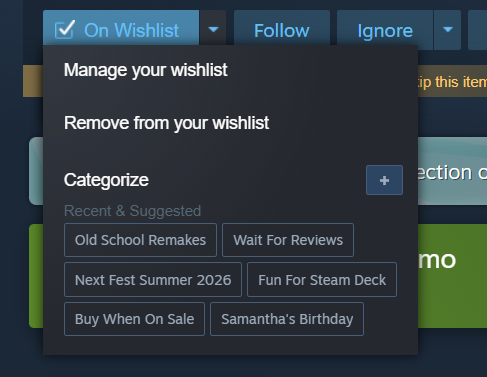
It is to this last group to whom Valve most obviously targeted this week’s update to the way wishlists work. And, in true Valve style, it seems at first like a minor change: categories. You can now separate out your list into games you’re waiting to go on sale, or are holding off on committing to until the review embargo lifts. You can curate a list of things you would very much like someone to buy you for Christmas (in an excellent supporting change, it is now possible to gift purchases to Steam members without holding an account yourself). Categories are user-defined — another Valve calling card; they would always prefer you to do the thinking yourself, and ideally most of the work too — so the sky’s the limit, really. I’ve only got 20 or so games on my wishlist, and if I’m honest I could easily bin off half of them if I had a spare half-hour, and could be bothered. But even I can see that these changes, while hardly big potatoes, are really quite cool.
So, well done Valve. But I found it hard not to read about these clever little changes without thinking about Sony (which at least made a nice change from thinking about Microsoft all the blessed time, my god). The PlayStation maker is still reckoning with the furious response to its decision to kill off physical game releases, and while the conversation to date has naturally focused on what we’re about to lose, it’s also important to consider what we’re going to be left with when it’s gone.
By which I mean: the PlayStation Store is dogshit. Sure, it’s come a long way since the days of the PS3 — when, a Sony bod once explained to me, whenever a new game was added they had to rebuild the entire store database from scratch, which is why you never knew what time of day a new release would actually land — but still: dogshit. It is barely fit for purpose. Did you even know PlayStation had wishlists? It’s the little heart icon in the top right of the store, next to the search button. You don’t get an email when a game on your wishlist comes out, or goes on sale. You get a push notification through the PS App if you’ve allowed them, which obviously would require you to be insane because notifications are the worst thing in the world, and the execution of the feature would likely drive you even madder (it sends a separate notification for each wishlisted game that's on sale, rather than bundling them up into one). You can get notifications on the PS5 itself, but the option must be turned on manually, and is buried towards the end of a very long list in the console’s most boring submenu. Like I said. Dogshit.
Wishlists are just one of several areas in which Sony’s digital store is not fit for purpose. (I recently had a hankering for a 2D platformer, and hit up the PlayStation Store to find that it doesn’t consider platformers to be a genre, or even a category.) If Sony truly intends for digital purchases to entirely supplant the physical games market in roughly 18 months’ time, it has a whole lot of work on its hands; the account-free gifting Valve just casually implemented should be the first thing on its to-do list given the traditional importance of retail stores when Christmas rolls around. But given the distinctly turdlike shape of the store today, and the attitude Sony has shown its customers over the course of the PS5 generation, I will not be holding my breath.
MORE!
- Might as well get all this week’s Xbox nonsense out of the way first, eh, in the faint hope of having some fun when it's over. Jared Palmer, one of Asha Sharma’s first hires after taking over from Phil Spencer, has quit his role as VP of engineering to join some miserable AI company no one outside Silicon Valley has ever heard of. “I’m grateful to Asha Sharma and everyone at Xbox for an amazing year,” he parped. It's only been three months, Jared. I’m sure the folks at Cognition will be delighted to have hired a head of engineering with such an eye for detail.
- You can now play four original Xbox games on PC, if that’s your bag, in what Microsoft is rather tenuously calling Backwards Compatibility. Next-gen bossman Jason Ronald says the initiative is “the beginning of a broader effort to preserve Xbox games from the past and bring them to PC over time.” The year is 2026, and Xbox is once again pitching Blinx: The Time Sweeper as some sort of saviour. What a world.
- Hugo Martin, co-director of id Software, has sought to downplay the severity of Xbox's latest layoffs. “There’s been reports that we've been nerfed into the ground and gutted and we have 50 people, and that's not true,” he harrumphed. “We're the size we were when we made Doom (2016) and id Tech is very much alive and well.” Speaking to Game Developer, anonymous id sources pushed back: “I've been a gamer my whole life,” said one. “If you cut a stat in half, everyone would call that nerfed.” Touché.
- Finally, Xbox’s long-mooted ad-supported cloud streaming is edging closer to release. To kick the feature’s tyres, members of the Xbox Insider scheme can now play games they own over the cloud. Ads only run at the start of a session, which is better than I’d feared — but said sessions are limited to an hour, which doesn’t sound great. What if you’re in the middle of a boss battle or something? Are they just going to boot you out? Bleh.
- The European Commission has merrily waved through the $55bn acquisition of EA by Jared Kushner, the Saudi Public Investment Fund, and half a dozen Death Eaters. The decision means the deal is almost certain to now go through, though given Kushner’s connections it was always going to happen anyway. I still find it hard to get too energised about this, you know. Like, lads, it’s EA. They haven't mattered for years.
- Just seven PlayStation games have sold more than 100,000 physical copies in the US so far this year, according to Circana research wizard Matt Piscatella. Yes, on the one hand, this suggests that the fury about Sony’s decision to kill off physical games has been rather overegged. But turning briefly to the back of Hit Points’ favourite napkin, 100k units seven times over, at $70 a pop, is still $49m worth of business; besides, it’s only July, and looking back over the big releases of the year so far I don’t see many games you’d expect to do mega-numbers at retail. Come back when GTA, COD and whatever FIFA’s called these days have been on shelves for a bit and we’ll talk.
- Hit Points tips its hat to Devolver Digital, which this week resurrected a casualty of Netflix’s ever-shifting gaming strategy. Poinpy, a well-regarded mobile game by Downwell creator Ojiro Fumoto, was a Netflix exclusive at launch in 2022, but was delisted last year in a 20-game cull after Netflix decided that catering to core game-likers wasn’t working out. The game is now back on the App Store and Google Play and is free — “Real free, not ‘mobile game free’”, as Devolver PR bod, Hit Points subscriber and general maker-of-cool-shit Andy Kelly put it the other day. Good stuff. Lovely stuff in fact. More of this sort of thing!
- In rather less good, but immeasurably funnier mobile-game news, this week indie studio Dropfake announced a DC Comics fighting game called, and I wish I was making this up, DCKO. Naturally the universe immediately decided it should be forever known as Dicko. I interviewed Will Wright a few years ago, and he told me how much he used to hate sitting in meetings with marketing teams who were trying to come up with names for his games. He wasn’t interested in the slightest; he didn’t think it mattered. What you saying now, Will?
- Hit Points wishes a happy first birthday to the lovely crew at This Week in Videogames, and a happy, erm, 0th birthday to Respec, a freshly minted sister to the long-running and reliably excellent RPGSite. Long live indie games media.
QUOTE OF THE WEEK
“I’m not just saying hello, Sega; I’ve got a little bone to pick with you. The fans would like to campaign for an update from you, Sega, about Shenmue IV. The Shenmue fans are amazing. You need to get your bottoms in gear, sort yourselves out, and get the update done.”
Count Binface, the man on whose shoulders the future of British democracy somehow rests, throws his weight behind the most vocal, organised, and honestly-a-bit-weird fandom on the internet. Very strange timeline, this, and getting weirder by the day.
There you go! Hit Points will be away next week for its annual sojourn to the British coast, and will return to your inboxes in the first week of August. As paid subs learned yesterday, I've been on quite the retro kick of late; as such I will be leaving the Steam Deck and Switch 2 behind, and relying solely on my 3DS for entertainment. Cannot wait. Cheerio!