#361: Pointless
And there goes Bluepoint.

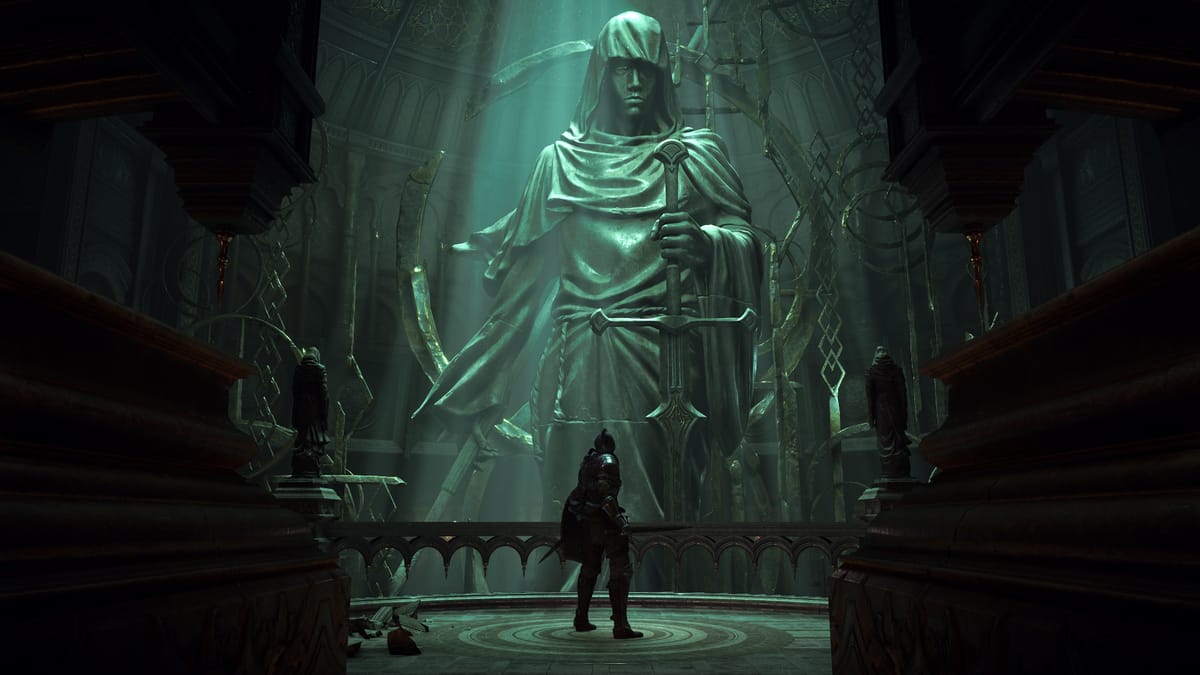
Yesterday Sony announced the closure of Bluepoint Games. Prior to its acquisition by the PlayStation maker in 2021, Bluepoint was the most well-regarded studio in the business when it came to remakes and remasters, putting its talents to loving tart-ups of Shadow Of The Colossus, Uncharted and Metal Gear Solid, among others, before its crowning glory, the lavish PS5 launch remake of FromSoftware’s Demon’s Souls. In a ten-year span beginning in 2011 it released six games, and had porting or support credits on a further four. In four-and-a-half years under Sony’s ownership it has released precisely nothing, its sole formal credit a support role on Sony Santa Monica’s God Of War: Ragnarok. There will be no more credits now. Bluepoint will close its doors in March.
The studio spent most of its time under Sony working on — do I even need to type this? You know what's coming — a live-service game. The title, set in the God Of War universe, was cancelled in early 2025 after Sony belatedly arrived at the obvious realisation that its attempt to pivot its entire family of studios, most of them renowned for their work on cinematic singleplayer blockbusters, to the pursuit of forever-game glory was a terrible idea that was doomed from the start. Bluepoint has spent the past year trying, and evidently failing, to get another game greenlit by Sony’s higher-ups. And thus, with wearying inevitability, has the axe again been swung.
To call this stupid would be an understatement. For one thing, there’s no need for it: PlayStation’s profits were up almost 20% last quarter, prompting Sony to raise the division’s full-year forecasts. For another, its impact on the balance sheet will be minimal. Bluepoint’s home of Austin, Texas is far from the most expensive place on the planet to make games — and certainly not the most expensive place in which Sony currently makes them — and its headcount of just 70 staff is dwarfed by Sony’s other prestige studios. At the time of Ragnarok's release, for instance, Sony Santa Monica employed around 400 people.
With new blockbusters taking longer and costing more than ever to make, and nostalgia never a more powerful currency, shuttering a proven specialist in remakes and remasters is frankly insane. Casting out a team of such deep technical expertise and, more crucially, such broad institutional knowledge — Bluepoint doesn’t just know its own tools and technology, but also those of the studios whose games it has modernised, from Sony Santa Monica to Naughty Dog, Team Ico to FromSoftware — is simply inexplicable. Pretending there’s nothing for Bluepoint to work on, when the market for remakes has never been bigger and the long-rumoured, widely coveted Bloodborne remake has reached Shenmue 3 levels of mythicism, is unbelievable. Everything about this decision, from top to bottom and viewed from any and every angle, is ridiculous, baffling, an affront.
In 2018 I spoke to Bluepoint president Marco Thrush, and technical director Peter Dalton, for an Edge cover feature about remakes and remasters. They told me that their games were effectively hybrids of Bluepoint’s in-house engine and whatever technology was used in the original work; Dalton described it as “a carefully choreographed dance, data handing back and forth between the two engines while delegating responsibilities and managing communication.” Each remake or remaster had its own needs, requiring new solutions to a new, bespoke set of problems. With every completed project, therefore, Bluepoint’s tech grew deeper and more powerful, as did the skills and knowledge of the people who worked on it. In an earlier Edge interview, way back in 2011, Bluepoint’s then-president Andy O’Neil estimated the average level of technical experience across the team at 15 years — and that was 15 years ago. What kind of idiot would chuck all that away?
Ladies and gentlemen, Hermen Hulst. Hit Points pointed out a little over a year ago that PlayStation’s co-CEO was up against the clock — that he had a “rapidly shortening window of time before these [doomed live-service] games stop being Jim Ryan’s legacy and start being his fault instead” — and I think the events of this week prove that deadline has now passed. Yes, it was Ryan who sought to reinvent the PlayStation Studios operation as a live-service dream team; it was in response to his call for pitches that Bluepoint devised its forever-GOW. But it was Hulst who served under Ryan, running the studio operation, enacting his master’s whims. It was Hulst, by then in the big chair, who shut the project down, then batted away every idea the studio subsequently came up with. It is Hulst who has now decided to close it, fully understanding that doing so means the surrender of all that talent, all that technical and institutional knowhow. Knowing all too well the incalculable reputational damage it will cause, likewise its barely perceptible impact on PlayStation’s P&L, but fucking well doing it anyway.
Hulst is styling it out, as you’d expect, penning a memo to staff that is so close in structure and tone to a Phil Spencer closure missive that I’m convinced he had one open in a tab while writing his own. Like Spencer, he starts with some tone-deaf trumpeting, playing up the successes last year of Ghost Of Yotei and Death Stranding 2. Then there’s the customary yes-but paragraph, citing the “challenging industry environment”, the “broader economic headwinds”, the “need to continue adapting and evolving”. Tell ‘em who you’re closing, offer platitudes to their departing talents, thank your staff for some reason, run a quick spellcheck and go. Textbook. If it wasn’t so cynical I would almost respect it.
Hulst owes Phil Spencer for more than just email inspo. We can credit an awful lot of Sony’s success in the PS5 era to the absolute clownshow Spencer has overseen at Xbox, its litany of reputational oopsies and dim strategic misplays casting Hulst and PlayStation in a far more flattering light than either of them deserve. On Hulst’s watch PlayStation Studios has been transformed from an industry-leading blockbuster dream team into a dysfunctional, creatively moribund group of studios who know their latest project is far more likely to get cancelled than it is to go out of the door. He has cranked up prices while emptying out the release slate, laying off workers and closing studios at a time when PlayStation games are thinner on the ground than ever. He grumbles about margins as if this is somehow all someone else's fault. He has the gall to talk of headwinds when it is clear as day, from this perspective, that he’s the one waving the fan.
Like Spencer, he has only himself to blame. Like Spencer, he is one of the few people in the industry with the power to change it for the better, yet appears only to be able to make it worse. And like Spencer, I hope to see him one day fired out of a cannon — literally, ideally, but at this point I'll take what I can get. It is becoming increasingly urgent.
There's no MORE! round-up today, I’m afraid. I’m in far too bad a mood. Will catch up on any big stuff we missed next week.
I normally love pulling an old Edge issue down from the shelf, but today it brought back a difficult memory. I was a couple of paragraphs into writing the cover feature when my heavily pregnant wife popped her head round the door of my study to say, hey, my contractions have started, you might want to hurry it up a bit. I’ve always worked well to tight deadlines, like, but that was a bit much. Reading it back this morning, I barely remembered writing a word of it.
If you, erm, appreciated today’s edition — I realise ‘enjoyed’ probably isn’t the right word — please consider helping keep the lights on chez Hit Points with a paid subscription, or a one-off donation through the Tip Jar below. Failing that, perhaps you’d give it a share? Forward it to a pal or shout it out on socials or something, it all helps. Thanks. See you next time.