#356: Critical hits
Larian's boss takes aim at dissenting voices, with predictable results.

I have long believed that, in the unlikely event that I should suddenly come into an unfathomable amount of money — a big lottery win, the death of some hitherto unknown billionaire aunt, a generous benefactor acquiring this newsletter for a few million quid (text me!), that sort of thing — I wouldn’t let it change me. Sure, I’d buy that big house in the lovely village, the one that was on my Edge commute, that I've lusted after for years and finally went on the market the other day. I’d make sure my friends and family were set for life. I’d definitely have the resources and floorspace required to knock up the custom lightgun arcade cabinet I daydreamed about to paid subscribers yesterday. But I’d still be me. My beliefs and values and all that would be unchanged. Definitely.
I am no longer quite so sure about that. It seems that there is no swifter route to completely losing the run of yourself than very quickly making a large pile of money. In gaming circles the great/horrible proof of this theory is Tim Sweeney, boss of Epic Games. Until Fortnite came along and he launched his important-but-deeply-dull crusade against app store revenue sharing, Sweeney seemed like the archetypal Good Rich Guy. One who talked about doing right by his staff and the wider industry, whose business practices were driven by a strong moral compass; who bought 50,000 acres of North Carolina wilderness to safeguard it from property developers, then gave 7,500 of them to a local conservation group for nothing. Perhaps Tim Sweeney is still all of those things, but if he is he’s got a funny way of showing it. All he really seems to be these days is a purveyor of low-grade Twitter snark designed to boost generative AI, techno-optimist nonsense and pseudo-libertarian rightwing politics, and generally own the libs.
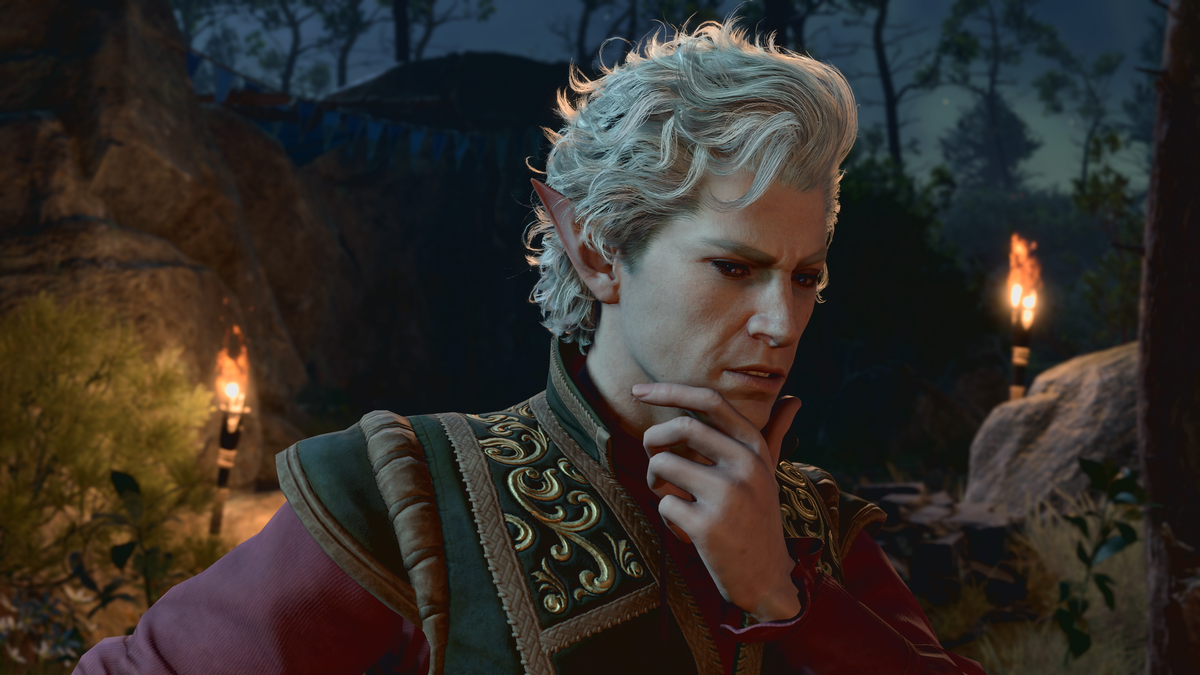
Sweeney has recently been joined on his regrettable crusade by Swen Vincke, boss of Baldur’s Gate 3 maker Larian and a man increasingly in the habit of making an absolute show of himself on Twitter. Vincke, too, has always seemed like a good dude, saying all the right things, giving inspiring awards speeches, using his newfound platform to hit out at shitty business models and the industry’s layoff mania. Yet it seems the rich-guy brainrot comes for them all eventually. Late last year Vincke caused a dismal stir with a bout of distinctly Sweeneyesque AI boosterism, the pushback to which was so severe — particularly internally, one imagines — that he ended up changing his company’s AI policy. If you thought he might have learned a valuable lesson from that experience, think again! He has, like so many rich tech guys before him, decided to simply carry on posting.
The latest chapter in this unfortunate tale came spewing from Vincke’s brain and fingers on Tuesday. “Sometimes I think it’d be a good idea for critics to be scored, Metacritic-style, based on how others evaluate their criticism,” he mused. “I like to imagine it would encourage a bit more restraint. The harsh words do real damage. You shouldn’t have to grow callus[es] on your soul just because you want to publish something.”
I do not need to tell you that people got quite upset with Vincke for this. Some saw it as the diseased wittering of yet another moneyed public figure who believes he is too successful to be criticised trying to silence, or at least demean, a troublesome press corps. Others pointed out that if anyone’s putting calluses on the souls of passionate game developers, it’s the edgelord player communities sending them (and critics, while we’re at it) death threats. Others still observed what an odd take this was from someone who employs an above-average number of former game critics at Larian, and who, in the run-up to BG3’s release, invited a gang of visiting previewers to his house for dinner. Most just went, Swen, mate, what the fuck are you doing? Stop posting!
Reader, he did not. To be fair, Vincke’s conduct since that wretched little post has suggested that there might still be hope for him; that he has not entirely gone off the reservation into billionaire-headloss land. After trying and failing to explain himself he’s walked it back a bit, just like he eventually did with his AI post, and deleted the tweet that set the whole outrage train in motion. “I really need to learn to weigh my words more carefully,” he sobbed. “I genuinely was trying to make a constructive argument but phrased it poorly.”
Good. Good and phew. I wonder why he has chosen to step back from the ledge. Perhaps he’s still a good dude at heart. I would certainly prefer to think that he is. Or maybe he just isn’t quite rich enough? I often wonder where the line is on this stuff; like, how much net worth you really need in order to completely untether yourself from reality. Just how rich do you have to be to get invited to one of Marc Andreesen’s demonic group chats, and get radicalised, and decide to devote your remaining time on this earth to posting abysmal shit on socials for a baying crowd of podcast guys, startup founders and sundry credulous idiots? Vincke, it seems, isn’t quite there yet, and I suppose there’s something sort of heartening in that. If he wants to edge a little further back from the precipice, he could always make himself a bit poorer and chuck me a few million. I promise I would spend it well.
MORE!
- I've never put too much stock in the annual GDC survey — it’s a small sample size, polling just 2,300 developers this year — but there are some pretty striking numbers in the latest edition. A third of US respondents say they’ve been laid off in the last 12 months, and almost half of them are still out of work. On the slightly brighter side, opposition to generative AI in game development is on the rise, despite what the executive class would have you believe. Just over half of those polled said AI was having a negative effect on the industry; while 52% might sound like a slender majority, it’s a notable increase from last year’s figure of 30%, and far outnumbers the paltry 7% prepared to say AI is all sunshine and rainbows.
- Microsoft did boring fiscal things this week, revealing another quarter of declines across the Xbox business. The division’s total revenue fell by 9%; sales of games and subscriptions by 5%; and hardware by 32%. None of this is surprising, of course. Quite how Phil Spencer and co intend to turn things around is a mystery, but we should definitely all be bracing ourselves for another round of cancellations and closures. Ugh.
- Five unions representing workers at ever-beleaguered publisher Ubisoft are calling for a “massive international strike”, running for three days in February, following the layoff-ridden restructure that wiped more than a third off the publisher’s share price. “We are treated like children who need to be supervised,” the unions said of the return-to-office mandate announced alongside the restructure, “while our management gets away with lies and breaking the law.” Woof. Ubisoft itself won’t be cowed: this week it announced plans for up to 200 more layoffs at its Paris HQ. They can't go on strike if you lay them all off, I suppose. Proper 4D chess.
- A UK lawsuit accusing Valve of anti-competitive practices will proceed to trial after an attempt to have the case dismissed fell on deaf judicial ears. The suit, launched last year, says Valve has abused its “dominant position” and left customers “paying too much for PC games and in-game content and hav[ing] lesser PC game platform alternatives.” If Valve loses, it faces having to cough up £656m by way of compensation, netting affected UK consumers a maximum of... £44 each. Is this worth it? Not sure! Doesn’t sound like it, but carry on.
- Amazon Games boss Christoph Hartmann has reportedly been sent packing, as the planet’s biggest retailer intensifies the waving of its white flag and abandons its designs on conquering the videogame industry. Hartmann, a c0-founder and former president of 2K, was one of just 16,000 workers laid off this week in Amazon’s latest quarterly bloodbath.
- Comcept, the indie studio founded in 2010 by Mega Man creator Keiji Inafune, has closed its doors. Comcept found early success on Kickstarter with the generously well-funded Mighty No. 9, which eventually appeared in 2016 and absolutely honked. His Xbox One exclusive Recore fared little better, and since then it’s pretty much been crickets from Comcept, though Inafune briefly reappeared a few years ago to pimp some NFTs. My only memory of Mighty No. 9 is asking Edge’s reviewer if I could possibly, pretty please, add two words to the end of their copy in order to do one of my little jokes:
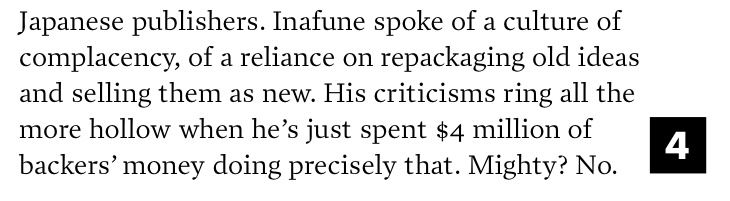
- Ah, print was fun. I miss it sometimes. Not for long, admittedly.
- Lastly, a hearty Hit Points shout-out to Jank, an already excellent indie-media venture from Rock Paper Shotgun alumni Brendan Caldwell, Jon Hicks and Graham Smith. Two of my former E3 roommates, fact fans, and a strong contender for the best URL on the internet. Instasub!
That’ll do! If you’ve read this far, I presume you’ve rather enjoyed it. Perhaps I could persuade you to financially support it too? As a solo operation with no advertising, SEO strategy or marketing capabilities, paid subscriptions are the only things keeping the Hit Points flame alive. Subscribing gets you two more midweek emails a month; a monthly weekend post about the games I’ve been playing; access to the full HP archive; and entrance to the Hit Points Discord, aka the last good place on the internet. Not bad, I reckon, for roughly the price of a coffee.
This month Hit Points hit an all-time high in paid subscriptions. The numbers are still modest, don’t get me wrong, but things are on the up and man, I’d sure like to see that trend continue. Thank you in advance. Have a stellar weekend, one and all, and I’ll see you next time.