#345: From the ashes
Went looking for a decent cricket game. Absolutely failed to find one.

My favourite disease, you say? What an odd question, but I suppose I’ll allow it. The answer is cricket.
Specifically, it's test-match cricket. Today was the first day of The Ashes, a five-match series of five-day games, played every two years, that’s been going on since the 1880s. It’s the biggest deal in all of cricket, particularly, but not solely, if you’re English or Australian. It’s in Australia this time, where England haven’t won a series for 15 years; they haven’t even won a match there in a decade. It’s brutally hot, the pitches are hard, fast and bouncy, and the English just aren’t used to it. They aren’t used to the flies. They aren’t used to a country that actually still cares about cricket on a grand scale, where stadiums double the size of our crusty, stuffy, Victorian-era English ones could be filled two or three times over. One of England’s opening bowlers could walk down the street in London and no one would bat an eyelid; in Australia he can’t leave the hotel without getting shit off the first person he sees, and just about every person he encounters thereafter. It is often said that, when England go to Oz for the Ashes, they’re not just playing a team; they’re playing a country.
The buildup to the Ashes is always a little insane because, as I say, test cricket is a disease, and as the coin toss for the first test draws near you can sense the fevers spike. The podcast-industrial complex has been hyping it up for months, mulling over squad selections and fitness concerns, debating whether this could actually be England’s year, no really though, it could (but admittedly probably won’t be). My YouTube homescreen is an absolute disaster, the usual mix of lawncare videos, Balatro high-score runs and DIY/baking tutorials hooked offstage and replaced with an Ouroboros of Ashes reaction videos. It's just an infinite scroll of thumbnails of gurning ex-pros who, when clicked on, go yeah nah, England can’t hack it in these conditions, 5-0 Australia. I will sit for an hour and watch them all, because, obviously, I am English and crave misery. But also because cricket is a disease and I am absolutely riddled with it.
Yesterday was Ashes Eve, which is a bit like Christmas Eve but with the excitement tempered by a creeping sense of impending doom. I was a jittery mess all day, and to take my mind off it bought the newly released Cricket 26, the latest in the semi-annual series of games from Australian developer Big Ant Studios. If you’ve never heard of Big Ant, that’s ok; while they’ve been around for 25 years they specialise in sports games, specifically sports that are very popular in Australia: rugby, cricket, lacrosse (?!) and the unfathomable nonsense that is Australian Rules football. Big Ant was bought by Nacon in 2021, the proud new parent promising to turn the studio into “the largest developer of sports entertainment software in the world,” which is pretty... let's go with 'ambitious' stuff given the incumbents in this space, the rather niche sports in which Big Ant has hitherto traded, and the quality of the games it typically produces. (Cricket is actually pretty big — 1.4bn Indians consider it their national sport — but that is yet to translate into success in videogameland.)
Big Ant’s cause will not be greatly helped by Cricket 26, which I’m afraid is absolute dogshit.
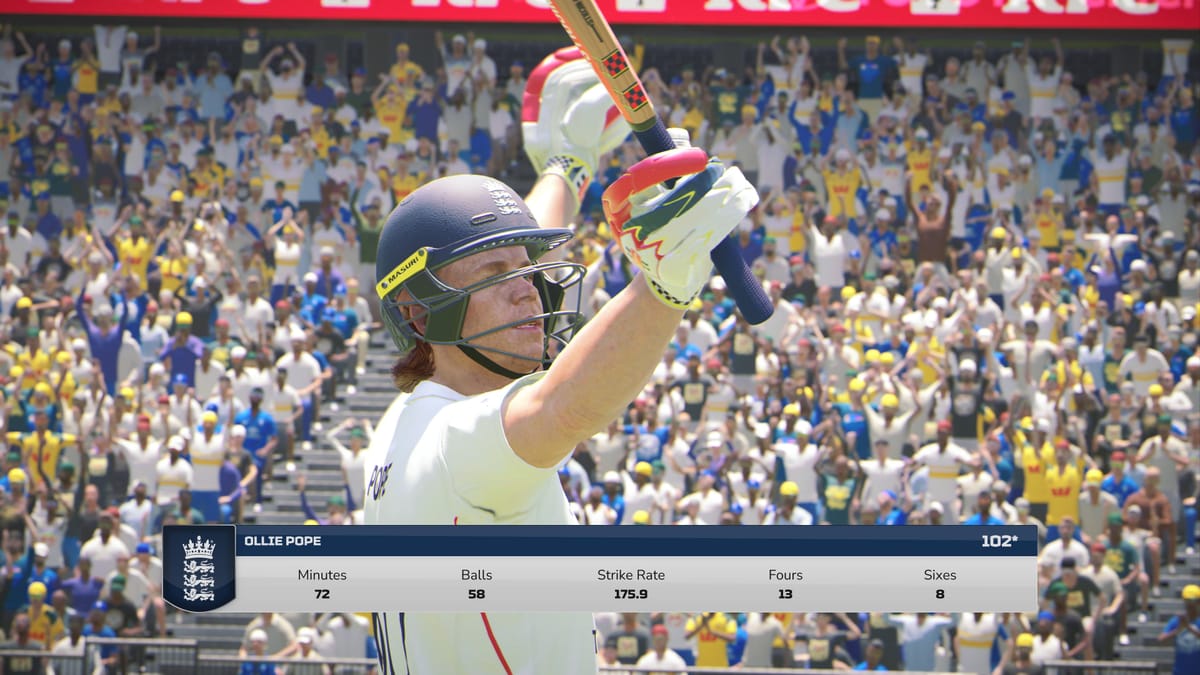
The visuals are — as polite a phrasing as I can muster, this — simply vile. Charitably, it looks like an early PS4 game, with some properly uncanny-valley approximations of the sport’s most famous faces. In audio terms it’s light years away from a FIFA or NBA 2K, with virtually no atmosphere from the crowd and the stilted commentary arriving late in the piece and often getting it horribly wrong. “That won’t hit the boundary but they’ll get a couple of runs,” one intones, as the ball thuds into the boundary rope. “Good shot but straight to the fielder,” says the other, a second-and-a-half after an English batter gets clonked on the helmet (I do not know the button for duck). The controls are a confounding mess, and the whole thing moves at a snail’s pace. It might look like cricket — one lad throws a ball and the other one tries to hit it; the sun shines beatifically while an Englishman (me) finds a creatively embarrassing way to get out — but there’s no nuance, no drama, no sudden swings of momentum or a sense that something is about to happen. None of the stuff I actually love about the sport, and its test-match variant in particular. It’s just wonky-looking lads hitting balls weirdly, while the commentator describes something else entirely. Fifty quid, this cost me. Fifty quid. Riddled.
I’ve been trying to write about test cricket in this newsletter, and elsewhere actually, for a couple of years now. You might think that’s an unlikely ambition for someone who writes about videogames for a living but I think test-match cricket is, actually and secretly, the perfect Roguelike. There are lots of interpretations of that word around these days, but for me it is best described as: a set of predictable systems, manifesting in unpredictable ways. Test cricket is all about predictable systems: a bowler and a batter, and some fielders there for catches; each team bats twice, and the highest aggregate score wins. There are obvious, human things to consider: left- and right-handers that require different angles, energy levels that need to be managed, strengths and weaknesses that dictate, or at least suggest, certain strategies. Normal sport-type stuff.
But then things get deep. Bowlers can adjust their throw speed, or their grip on the ball, to produce minute variations in flight and bounce. Batters can hop about in their crease at the last minute to disrupt the bowler’s plans and create new angles for shots. As the ball ages and its lacquer wears off, it begins to behave differently, getting slower, but weirder. The pitch does likewise over the five-day match, the pristine bouncy day-one surface wearing down under the load, cracks and worn-in footmarks making the ball’s trajectory after it bounces steadily less predictable. Pitches are different in every cricket-playing nation — there are two kinds of soil in India! This is actually very important! — and the climate plays a similar role. In England, overcast conditions make the ball ‘swing’ sideways through the air; I have seen entire test matches turn on a ten-minute cloudy spell. In Asia, dew can spawn late in the day, the ball skidding on to make batting more predictable, and the wet ball harder for bowlers to grip. I could go on about this all day, honestly, but this paragraph’s gone on long enough and I think you get the idea. Test cricket has all these ways to get weird and, over the course of five days, that makes for quite a spectacle. Something wild can happen at any moment; only a fool would look away.
There’s none of that in Cricket 26, of course. None of that at all. But it got me through a fraught couple of hours on Ashes Eve, and I suppose I should be grateful for that. I turned off the PS5, set my alarm for 2am so I could be up and about for the first ball of the series — riddled! — and took myself off to bed. If anyone needs me for the next six weeks, I’ll be living on Australia time. With a terrible fever, and probably in quite a bad mood.
That’s your lot today, I’m afraid. I am sleep deprived and have a terrible disease and need a lie down. Will make it up to you! Have a lovely weekend.
(After all that nonsense up top, it would be remiss of me not to mention Card Cricket Quest, which in a remarkable coincidence was unveiled this morning by the Hit Points chums at Jump Punch Kick. A fuckin’ deckbuilding cricket Roguelike? So up my street I think I can hear it outside right now. Give it a look. Bye!)